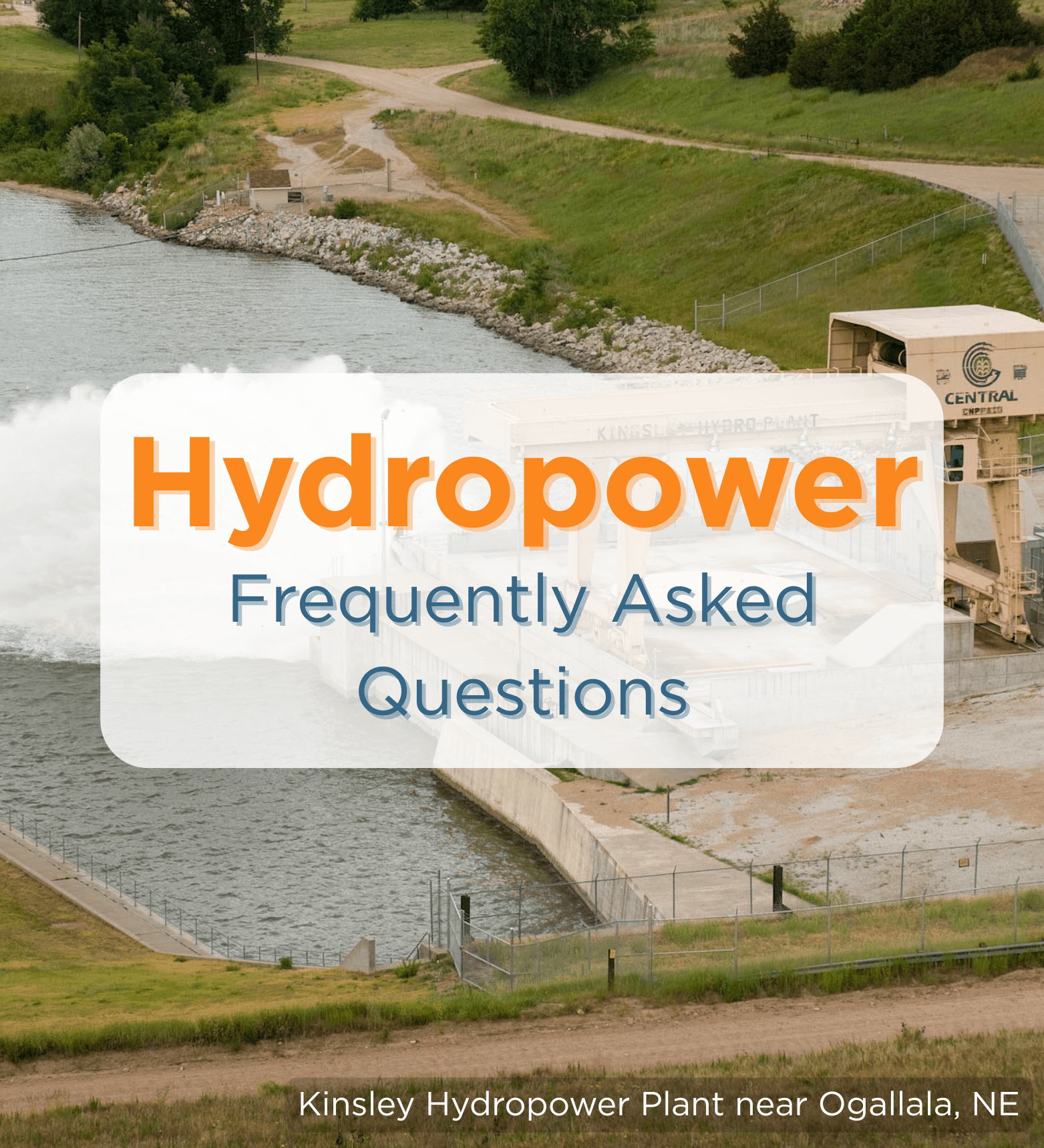
- Hydropower in Nebraska
- How does hydropower work?
- How can hydropower act like a battery?
- How long is hydropower's lifespan?
- If hydropower is so consistent and effective, why isn't it used more?
Hydropower in Nebraska
An often overlooked part of Nebraska’s generation portfolio is hydropower. Nebraska has 9 hydroelectric power plants, utilizing water from Lake McConaughy, the Missouri River, and other sources to produce about 2% of the state's electricity needs in 2023. The amount of production is dependent on flows in our rivers and streams and consequently varies year to year.
How does hydropower work?
Hydropower (also known as hydroelectric power), much like how wind turbines harness the energy of wind, uses the kinetic energy of water flowing downstream to spin turbines which generate electricity. Typically, the amount of energy generated is dependent on the volume of the water flowing through the turbines as well as the change in elevation, also known as the “head”. A steeper change in elevation means that more energy can be generated. This is why most hydroelectric dams create artificial rapids and/or waterfalls. Below is a brief video depicting how this process works.
How can hydropower act like a battery?
When most people think of batteries, they think of things like lithium-ion or lead-acid batteries; however, hydroelectric dams can also act as a battery of sorts! Essentially, when energy demand is low but production is high, that excess energy can be used to pump water that has already moved past the dam back up to the dam’s reservoir, where it can be stored for extended periods until extra energy generation is needed.
How long is hydropower's lifespan?
Typically, hydroelectric turbines are cited as lasting for 25 years; however, it is not uncommon for hydroelectric facilities to last far longer than that. For example, the Ames hydroelectric project near Telluride, Colorado initially began commercial operation in 1891, making it over 130 years old as of 2025! While it has received upgrades and regular maintenance, this 3.6 MW hydroelectric plant shows just how long-lived a well-maintained and properly placed hydroelectric plant can be.
Some of the factors that determine the lifespan of a hydroelectric plant are things like normal wear and tear on the physical structure of the dam (freezing & thawing, chemical reactions, erosion, etc.), availability of water (too little and it can’t generate power, too much and it could overflow or rupture the dam), and the maintenance of pipes and other mechanical equipment which can include clearing debris and dirt from the turbines.
If hydropower is so consistent and effective, why isn't it used more?
While hydropower can be a very effective and reliable method of generating electricity, it, like all other forms of generation, has drawbacks.
The first issue is the easiest to understand. To have hydropower, you have to be where there’s lots of water. This restricts where hydroelectric generators can be located, making dry areas like the southwest United States less viable for this source of power. Of course, even small waterways like streams or creeks can function as hydroelectric generators, but they are more prone to drying up than larger waterways, which leads to our next major issue: water supply.
Just like with any form of energy generation, hydroelectric power requires fuel to generate electricity. In this case, water flowing through its turbines. With hydroelectric plants’ long lifespans (sometimes upwards of 100 years), it’s possible that the source of water that powers the turbines can dry up, severely reducing the plants’ output or even rendering the plant functionally useless. The Hoover Dam, probably one of the most famous hydroelectric dams in the United States, has seen its power output drop by nearly half, over 1000 MW, as of June 2022 due to reduced water levels in Lake Mead brought on by drought and increased water use along the Colorado River.
On the flip side, rapid flooding events can also cause issues for hydroelectric generators. In areas all around the world, including the United States, instances of quick and heavy precipitation have led to dams overflowing or even collapsing.
The last key issue with hydroelectric generators, particularly with larger ones, is that it can heavily affect the surrounding area and impact aquatic wildlife. One of the ways that hydroelectric dams maintain reliable power output is by storing up water in a reservoir. By allowing water to build up in a reservoir, the dam is effectively storing power for later use; however, it also floods the surrounding area which in turn generates methane and carbon dioxide as microbes digest submerged organic matter. Dams also affect wildlife like fish by fragmenting the rivers, changing their sediment and temperature levels, shifting the way the river flows, and more. Not only does this hurt the ability of fish to forage for food, it also can keep them from reaching their natural spawning grounds, which can significantly impact their numbers. Some common solutions to assist impacted wildlife are to create fish ladders, an alternative route which allows fish to more easily bypass the dam structure, and/or to have a minimum flow value which determines the lowest amount of water that the dam must release to maintain the health of downstream ecosystems.
