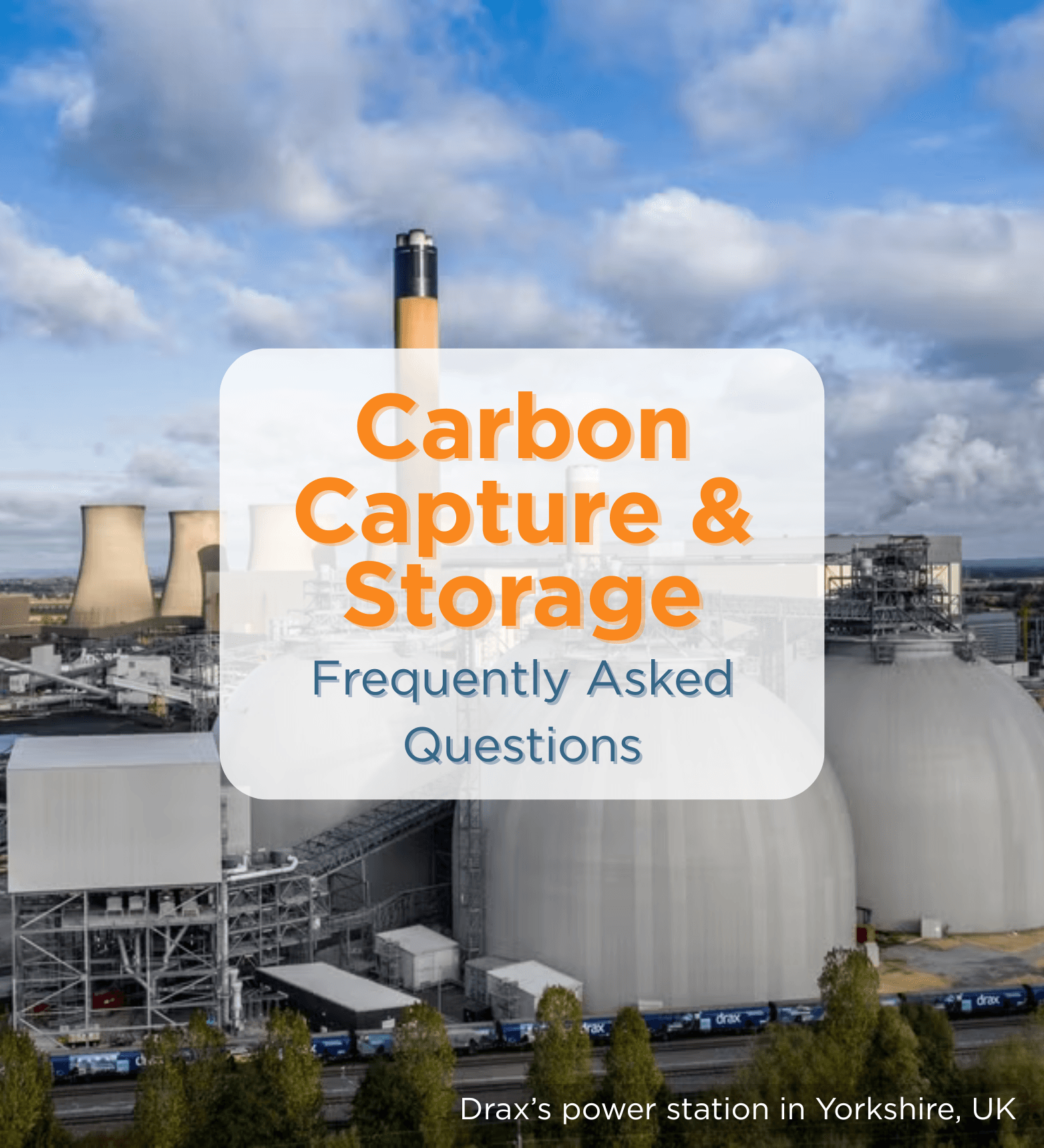
- What is carbon capture and storage?
- How long has carbon capture and storage been around in the U.S.?
- How common is carbon capture and storage?
- Is carbon capture and storage safe?
- How much does it cost to run a capture and storage system?
- What are common concerns regarding carbon capture and storage?
What is carbon capture and storage?
Just like its name implies, carbon capture and storage (CCS), involves capturing CO2 released in industrial processes or the burning of fossil fuels for energy generation, compressing it, then transporting it to be stored (typically underground in geological formations). This occurs at the source of the pollution, for example, in a coal plant’s smokestack where CO2 is more heavily concentrated. It should not be confused with direct air capture (DAC), which can be located anywhere, takes CO2 directly out of ambient air, and is currently far more costly to run.
CCS can be an appealing option when it comes to high emission industries like cement production and steel manufacturing, where pollution reduction is particularly difficult to achieve.
How long has carbon capture and storage been around in the U.S.?
The first commercial use of CCS in the United States was in 1972, when the Terrell Gas Processing Plant in Texas installed the system to capture CO2 and transport it to a nearby oil field for use in enhanced oil recovery.
How common is carbon capture and storage?
According to the Global CCS Institute, as of 2023 there were 392 CCS projects in various states of development and/or operation globally. The majority of these projects are still in development. 41 of these projects are in operation globally, with 14 of those being within the United States.
While that is a relatively small number of CCS systems, this number may soon increase within the U.S. due to the announcement of the EPA’s new coal plant regulations. These regulations require that coal plants operating past 2039 reduce their pollution by 90% by 2032, with CCS systems being the only technologically feasible method for those reductions without changing fuel type. This is assuming that the regulation remains in place, as it has run into legal disputes since it was announced and may change as disputes are resolved.
Is carbon capture and storage safe?
As with any practice that involves potentially hazardous material, CCS does come with certain risks. These can include the leakage of CO2 from its underground storage into water systems as well as transport pipes rupturing and leaking CO2 above ground. The latter scenario, if it occurs, can create a situation like that seen in Satartia, MS where breathable air is displaced by the denser CO2, leading to potential asphyxiation as well as rendering combustion engines (like those in gas-powered cars or emergency response vehicles) incapable of operating.
The Department of Energy’s National Energy Technology Lab states that CCS is largely safe. Underground storage of CO2 has been in practice for many years to enable enhanced oil recovery (EOR), where CO2 is pumped into oil reservoirs to displace the resource, making it easier to extract. The main takeaway is that, while there are potential dangers with CCS, responsible monitoring, management, and emergency preparedness can prevent issues and mitigate their impacts.
How much does it cost to run a carbon capture and storage system?
While the technology has been around for several decades, carbon capture and storage is still quite costly to operate. In a 2023 article by the International Institute for Sustainable Development (IISD), it was estimated that running a CCS system at a coal-fired power plant would cost anywhere from $16-120 per metric ton (2,204.6 lbs) of CO2 captured. To put this into perspective relative to Nebraska, we’ll need to do some math.
Coal produces roughly 0.88 kWh/lb, which means that 1 short ton (2,000 lbs) of coal would produce around 1,760 kWh of electricity. If we take the 2024 residential price of a kilowatt in Omaha, NE, about $0.11, then burning a short ton of coal would create $193.60 worth of electricity. Many of the coal plants in Nebraska run on coal from the Powder River Basin, which is classified as subbituminous. Subbituminous coal produces approximately 3,693.82 lbs of CO2 per short ton of coal. This is equal to 1.676 metric tons of CO2 produced. Using IISD's median price estimate of $68 USD/metric ton CO2 captured to run a CCS system, that means that for every short ton of coal burnt, you’d need to spend roughly $113.97 to capture the CO2 that it produces. This leaves $79.63/short ton of coal in revenue for the power company to put towards maintenance, operations, and other costs. In other words, a coal-burning power plant serving Omaha would be spending 58.87% of its revenue from residential electricity generation on capturing CO2 (unless they increased the price of electricity to account for the increased cost).
While it is expected that these costs will decline as CCS is more widely adopted and manufactured (much like solar and wind), the high complexity of their designs as well as the need to customize them to different industries limits the expected cost reduction.
What are common concerns regarding carbon capture and storage?
Another concern that has been raised in association with CCS is how underground storage of CO2 does have the potential to cause seismic activity as soil and rock formations are disturbed by changes in pressure. This can, in certain cases, lead to CO2 leaking from where it’s stored and potentially putting nearby areas at risk; however, it should be noted that, with proper siting and operation, this is a rare occurrence and even high magnitude earthquakes are not guaranteed to cause these issues. For example, in 2004, a 6.8 magnitude earthquake hit near a CO2 injection site in Nagaoka, Japan. The site briefly paused operations due to safety concerns; however, it soon resumed injections after no leaks were detected.
