- What are battery storage systems?
- How does battery storage help improve renewables?
- Do batteries create any noise?
- How long can batteries provide power?
- What size are batteries and where are they usually stored?
- Are the batteries dangerous?
- How long do batteries last and what happens to them when they are retired?
What are battery storage systems?
In most cases, battery storage systems utilize the same technology as a phone or electric car battery, except they are far larger and can store and provide much more energy. Batteries allow a utility to put away a portion of the energy they generate for use later. Currently, most battery storage systems use lithium-ion batteries, but there continues to be research and new innovation into different types of battery storage systems. Some notable examples of battery storage in Nebraska include OPPD’s Weeping Water battery storage, Norfolk’s Sunwise battery storage, and the batteries LES commissioned to help power the Lincoln microgrid.
How does battery storage help improve renewables?
Much of the difficulty in transitioning fully to renewable energy is the fact that sources like wind and solar are intermittent, meaning that they are not always producing power if conditions are not right and they sometimes produce more energy than we need at that moment. The way that battery storage helps is by storing extra energy that is produced when energy demand is low but generation is high, like a windy spring day where temperatures are comfortable so not many people are cooling their homes. Then, when there is more demand for energy, the batteries can use the stored energy to bridge the gap at times when that energy is most needed. Battery storage can be used effectively in combination with most other types of energy generation - not just in combination with renewables; however, it is most commonly used with renewables since they are the cheapest energy sources.
Because of the low cost of renewable generation, battery storage allows for price arbitrage opportunities as well. Price arbitrage describes when a resource can be sold at different prices depending on location or timing. If a utility can buy energy when it is cheap (regardless of source) and store it in batteries, it can then use or sell that energy to other utilities when it is more expensive, keeping the difference between those prices for itself. In Nebraska, where we have public power, our utilities are legally prohibited from making profits and would instead invest all of their revenue into infrastructure improvements, or reduced rates for all of us. Consequently, batteries both improve the function of the grid today, and its function in the future by enabling additional investments.
Do batteries create any noise?
Battery energy storage systems (BESS) can produce noise, however, the noise levels are typically low and manageable through mitigation measures. The majority of the noise produced comes from cooling fans and inverters that allow the batteries to convert direct current (DC) electricity they store into alternating current (AC) we get from our wall outlets. Just like with solar panels, most of the noise generated will be on warmer days as the cooling fans work harder to reduce the temperature of the batteries. Various measures like soundproof enclosures, noise barriers, and strategic placement of equipment are effective in reducing noise levels of BESS.
How long can batteries provide power?
Utility-scale battery storage, like any other kind of battery, can have a varying battery life depending on the amount of demand on the system. Typically, a utility-scale battery is rated for two variables: capacity and duration (e.g. the most energy it can provide at any given moment and for how long it can provide that amount). Utility-scale battery storage systems typically provide power for durations ranging from a few hours to up to 12 hours, depending on the specific technology and configuration. Most systems, particularly those with lithium-ion batteries, are designed to provide power for around four hours at their rated capacity. By adding more batteries, the amount of power stored and therefore the duration that they can provide power to the grid also increases. Conversely, increasing the demand on the batteries (more homes using power, more power used per home, less support from other generation, etc.) will shorten the timeframe in which they can provide power.
Other "batteries" can store energy for days, weeks, or even months. Flywheels, compressed air storage, or pumped-hydro storage are all examples of technologies used to store energy for when we need it. The simplest of these is pumped hydro, where a pipe is added next to a dam that can pump water back uphill when there is extra energy. Then, when you need that energy, the water flows back down through the dam, providing power.
What size are batteries and where are they usually stored?
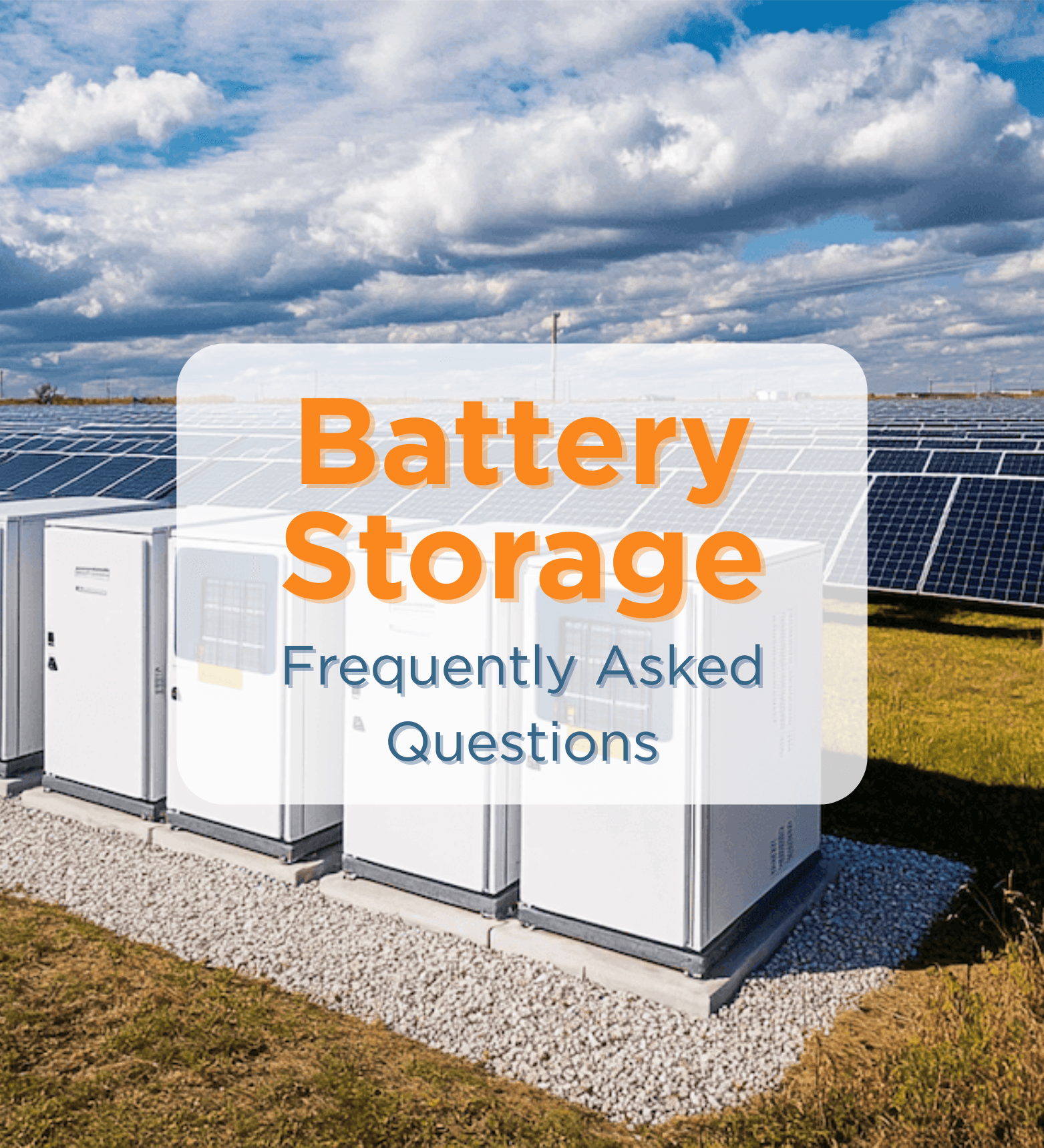
Batteries can generally be divided into three categories of ascending size: cells, modules, and packs. You can think of cells as looking like a AA battery, with modules being dozens or hundreds or cells connected, and a pack being several modules being connected together. Battery storage systems can vary widely in terms of size based on how much energy they are intended to store as well as the chemistry of the battery being used. Most typical utility-scale battery storage systems are about the same size as a shipping container. According to battery developer, Convergence, a good rule of thumb is to expect 1000 square feet of space to be used for each megawatt hour of storage. Usually, batteries are placed in locations near where energy is being generated or transported, like solar farms or substations for transmission lines. High-demand areas such as densely populated cities or industrial sites, or nearby existing electrical infrastructure, are ideal locations for battery storage. By placing batteries near where the energy will be used, the amount of energy lost in transmission is reduced.
As companies get better at making cells, their price will come down, making it possible to store more energy for less money. Similarly, companies are looking into different chemistries for the cells and continuously find ways to store more energy within them, making it possible to store more energy in the same volume. These two genres of innovation push the technology forward, and help account for the significant reductions in battery prices observed over the past decade.
Are the batteries dangerous?
As with any technology, battery storage does have the potential to fail. The most dangerous type of failure seen with these systems is thermal runaway. Essentially, this means that one or more battery cells are producing more heat than they can dissipate, which can then lead to a chain reaction where more cells begin to heat up and may result in a fire.
Despite the danger, it should be noted that thermal runaway is a rare occurrence, with only 12 recorded incidents worldwide in 2022 despite increasing amounts of battery storage. Battery manufacturers have found as the technology advances, there are many ways to reduce the chance of thermal runaway as well as minimize the danger should it occur. One method of prevention is to change the chemistry of the battery, such as switching to sodium-ion instead of lithium-ion, which can improve the stability of the battery and increase its lifespan and/or storage capacity. Another prevention method is to keep the batteries operating within their ideal temperature range (typically 40-70°F for lithium-ion batteries). This minimizes the stress put on the batteries, keeping them stable and extending their lifespan. Additionally, by placing the batteries in an area with no combustible material (i.e. an area covered with gravel or concrete and clear of vegetation), the chance of a spreading fire is mitigated. Furthermore, proper training of local emergency response teams will help reduce the likelihood of severe incidents.
According to the Electric Power Research Institute (EPRI), the yearly global incident rate fell 97% between 2018 (9.2 incidents/gigawatt) and 2023 (0.2 incidents/gigawatt). As battery storage becomes more commonplace, improved management and production is likely to lower incident rates even further.
How long do batteries last and what happens to them when they are retired?
Battery longevity is determined primarily by chemistry, cycling, and depth of charge/discharge. According to Alsym Energy, the main determining factor is the chemistry of the battery. A lead-acid battery is likely to need replacement after roughly 5-10 years while a lithium-ion battery (depending on its exact chemistry and usage) is more likely to last between 10-15 years. Usage also plays a big role. Like a tire or a t-shirt, the more something is used the more likely small amounts of damage will accumulate. Since batteries discharge and charge repeatedly, their use is measured in cycles which generally means how many times a battery is fully emptied and then fully recharged. Additionally, the depth of discharge (the amount of power taken from a battery during its use) plays an important role. You may have heard not to leave your phone plugged in when the battery is full. This is because a battery is most vulnerable when nearly full (80-100% charged) or nearly empty (0-20% charged). Keeping batteries from regularly operating in those ranges has been shown to preserve their capacity. Lastly, the temperature at which the battery is kept can affect its lifespan. Extreme temperatures and higher amounts of energy being discharged can reduce a battery’s lifespan more quickly.
The good news is that when a battery does reach the end of its functional life, it can be recycled and its components reused. Lithium, nickel, manganese, copper, iron, and other metals within battery cells are infinitely recyclable, meaning that as long as someone is willing to process it, the material can be used over and over again with no issue.
Batteries for utility scale storage are a relatively new use. Looking at the recycling rates of lithium ion batteries used for cell phones, we know that, unfortunately, because of the complexity of recycling lithium-ion batteries as well as its currently high cost, most lithium batteries are disposed of rather than recycled. According to Battery Recyclers of America, the US recycles only around 5% of lithium batteries. However, lead-acid batteries, which have existed for much longer than lithium batteries, are recycled at a very high rate, demonstrating that once the industry is established, the cost savings of reusing raw materials for new batteries creates powerful incentives to create robust recycling networks. Despite the difficulties in recycling lithium batteries, there are efforts underway to develop safer and easier methods. For example, the Department of Energy opened up their ReCell Center in 2019, which functions as a battery recycling research and development center.
From a national security perspective, battery recycling is being eyed as a way to enhance domestic supplies of important materials. By creating a robust recycling network, the material in imported batteries can be extracted at the end of the batteries’ useful life, separated, and remade into new batteries all without having to import new materials. If one then considers the likely advancements in battery production between when that battery is first manufactured and when its pieces are repurposed into a new battery, it may be that those same materials can now be used to store more energy than before.
