Why does clean energy make sense in Nebraska?
Nebraska has the potential to be a national leader in clean, affordable energy - we rank 4th in wind energy generation potential and 10th in rural solar potential, but we aren’t taking full advantage of this opportunity despite the enormous benefits it can bring. According to the DWEE, as of late 2024, Nebraska is ranked 15th in the nation for installed wind. As of June 2026, Nebraska was ranked 49th for installed solar according to Solar Energy Industries Association.
When renewables are proposed in Nebraska, sometimes people will ask questions like “Why here? Why should renewables be built in our state? Aren’t there other places it could be instead?” The answers to these questions are twofold.
First, this development is happening in other places, often being installed in other states significantly faster than Nebraska. It is not a question of building here or there, but here and there, since distributing our generation resources across the country ensures we are capturing the energy wherever it is and transporting it across the grid to wherever it is needed.
Second, Nebraska has exceptional potential to generate power through renewable energy when compared to other states. For a bit of background, renewable energy resources like wind and solar are known as “intermittent generation” because they produce energy sometimes, but not all of the time. It is important to note that to some extent, all energy is intermittent regardless of source. Whether it is a nuclear power plant that needs uranium removed and new fuel put in, a coal plant that needs to do repairs or maintenance, or a gas power plant that is expensive to run and is only turned on during the highest demand periods, there are times that generators are shut down for weeks or months before resuming operation.
Solar is less productive when it is cloudy (but still produces), and does not produce electricity at night, while wind turbines remain stationary when there is no wind blowing or the wind is blowing too fast. Logically, the best place to put these resources is where the weather is sunniest and/or consistently windy so they run most often. This is captured by a statistic called “capacity factor” which expresses how much energy a given resource is producing over time compared to how much it could have produced at it's maximum capability.
This is why solar started rolling out in the American Southwest in states like Arizona, Nevada, California, and New Mexico. The dry climate that created deserts in this region also means there is abundant sunshine with very few cloudy days. Additionally, since the region is closer to the equator, the days are longer than they are further north. These conditions mean that solar will have a much higher capacity factor in that region than anywhere else in the country.
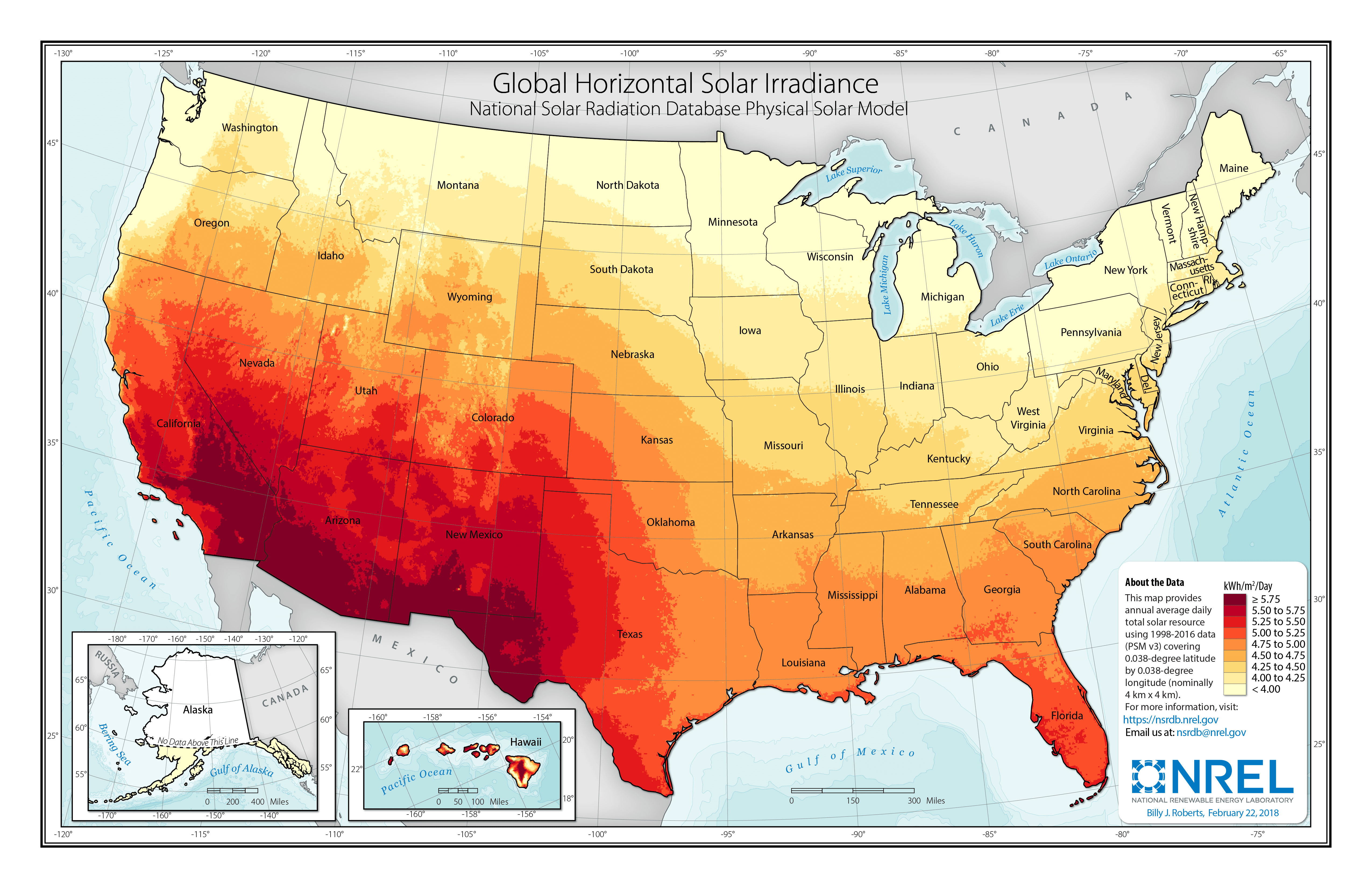
Likewise, wind is most productive in the Great Plains because the region hosts the best conditions for wind in the country. Our location between the warm wet air from the Gulf of Mexico and the colder, dryer air from Canada means there is often a lot of mixing of air as temperatures try to reach equilibrium, generating lots of wind in the process. Additionally, air masses moving from the West Coast get pushed up by the Rockies, cooling the air. As the cold air sinks, they rush down and sweep across the relatively flat Great Plains, meeting little interference and resulting in a high capacity factor for wind.
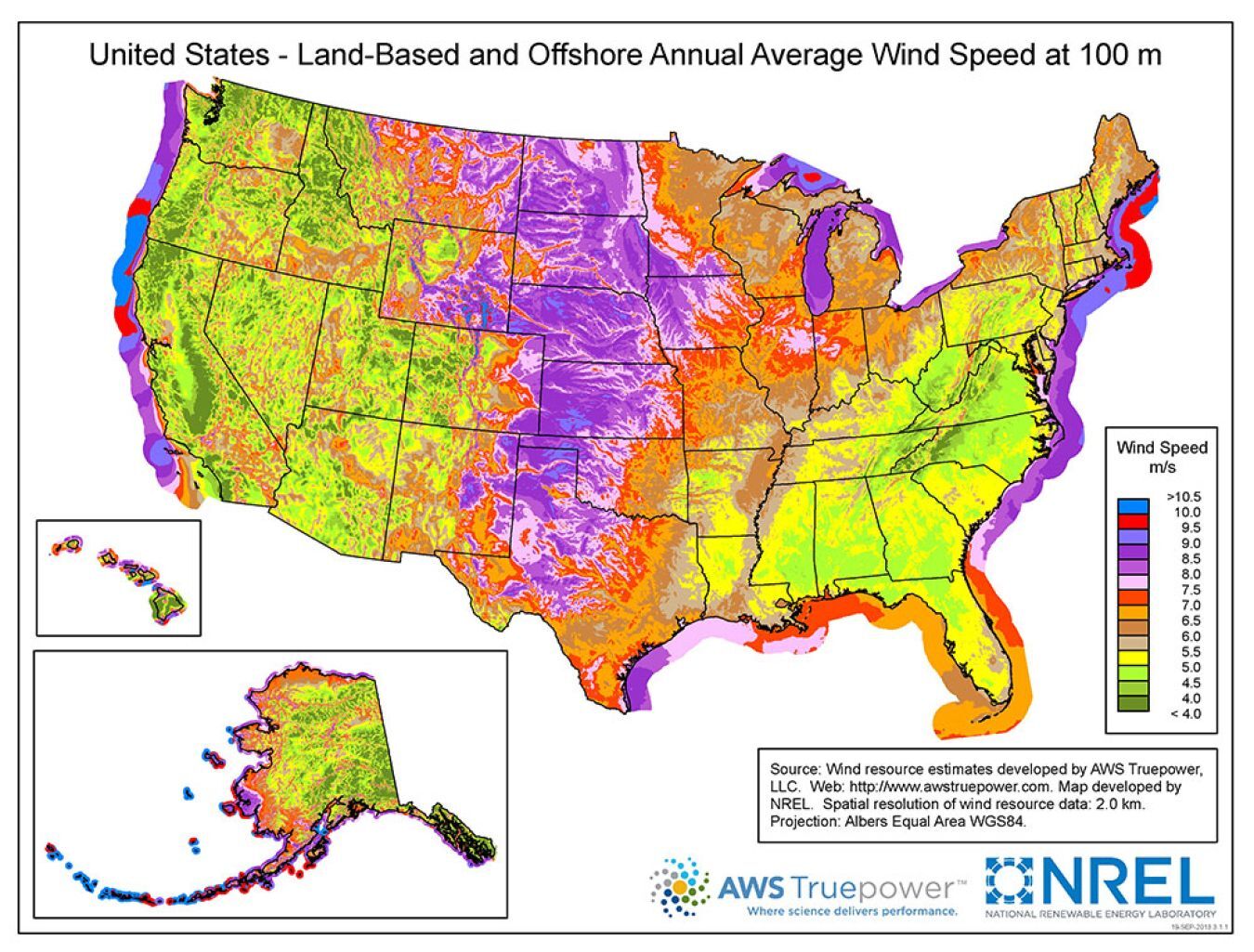
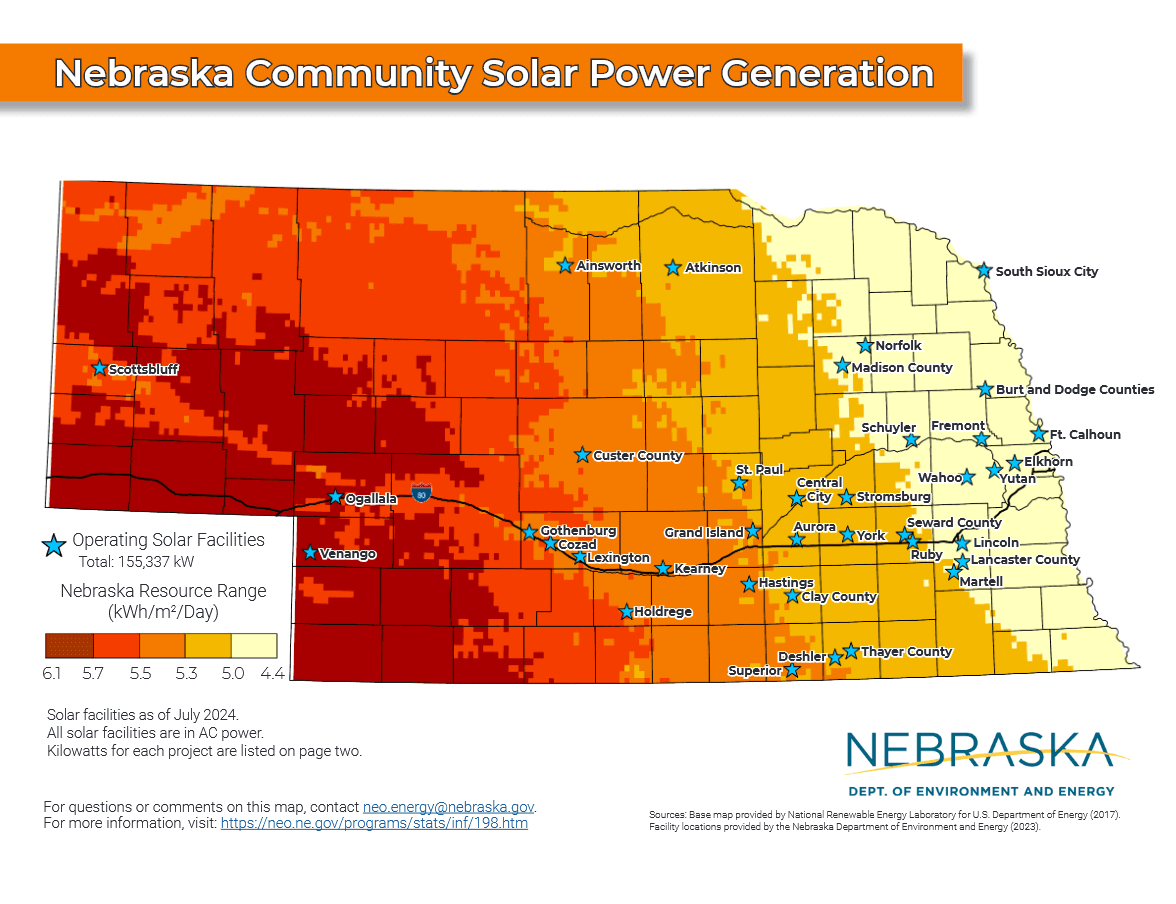
So, let's return to the Nebraska level and the “Why here?” question. Starting with solar, the map below shows the average solar energy hitting the ground in different parts of the state. The darker colored regions are often sunnier because of climate conditions. The western part of the state is drier which generally means fewer storms, fewer storms means fewer clouds, and so these parts of the state experience sunshine more often than the eastern part. This means solar placed here is able to generate electricity more regularly.
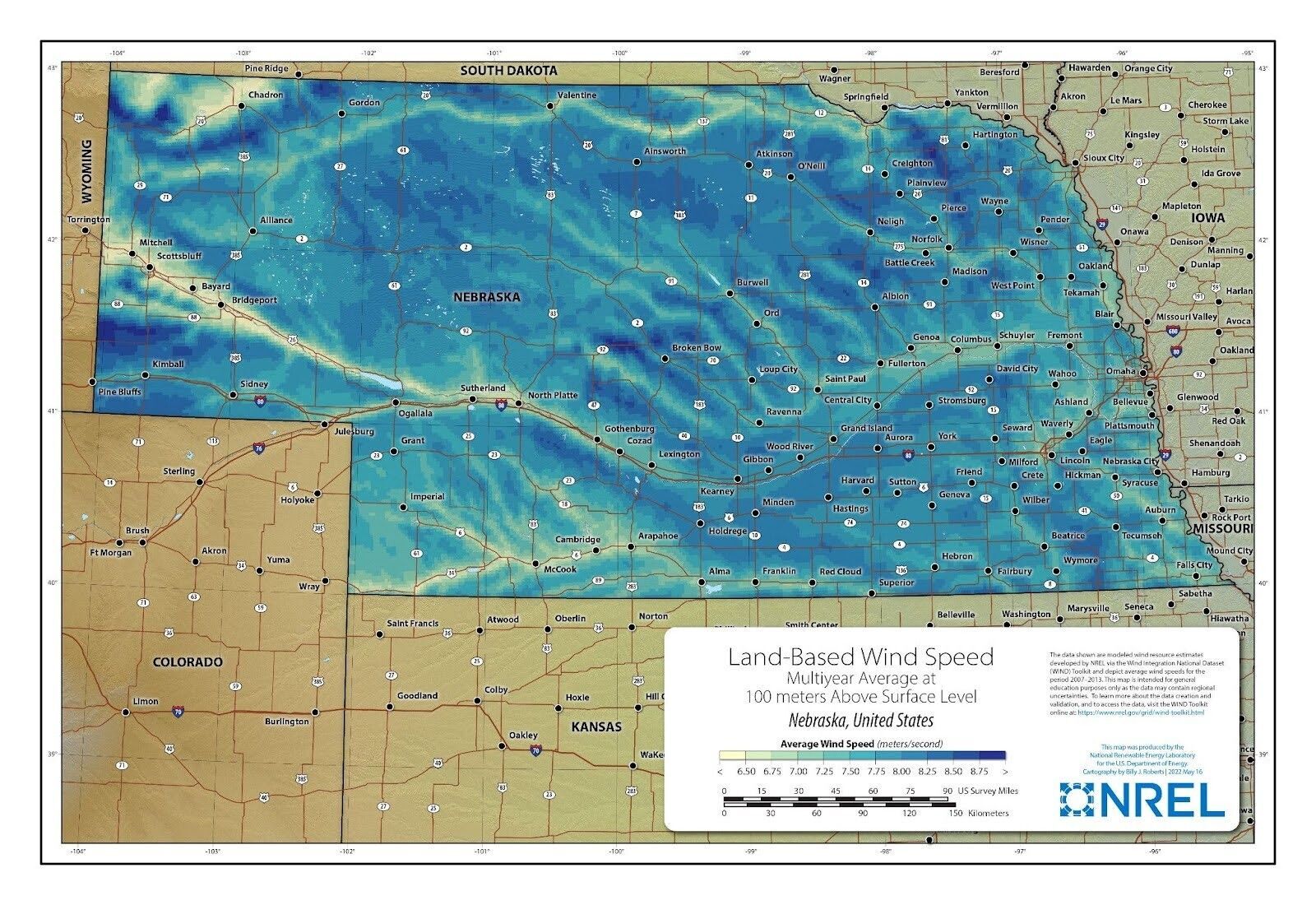
Meanwhile, the map below shows that wind averages consistently high speeds across the entire state. Like with solar in the Southwestern US, it makes sense on a national level to focus our wind turbines where they will be most productive: here! With consistent and quick-moving winds, wind turbines would have a much higher capacity factor and would produce a much larger amount of energy as compared to other regions.
Now that it is clearer why wind and solar development makes sense in Nebraska on the production or supply side, let's talk about the demand side. Nebraska's industrial electrical customers use about 45% of our total electricity consumption as a state. Most of these customers are in agriculture, and much of their usage is related to irrigation during the summer months. Renewables here provide several advantages, similar to the advantages they provide utilities. Cost is one. Powering things with electricity is cheaper and more efficient than fuels like the diesel typically used to power center pivots. Building out renewables lets utilities and cooperatives keep prices in check, and producers buying their own renewables enables further cost savings.
The next is security and reliability. Having generation located closer to where the energy is used reduces expenses for transmission infrastructure, but also improves the ability of communities or individual property owners to weather storms that might otherwise threaten their electricity supply. Referencing the Nebraska Community Solar Power Generation Map, note the stars which indicate towns that have installed solar farms to meet a significant portion of their electricity needs. If a transmission line were to be downed by a storm or lightning strike, there is now a backup energy source to power the critical needs of the community (freezers, medical devices, etc.).
Related to security is the fact that having local renewable energy reduces our reliance on importing fuels from other states or countries. Take coal for example. In 2023, roughly 45% of Nebraska's energy was produced by coal-fired power plants. To fuel those power plants, in 2023 Nebraska imported nearly 12,000,000 tons of coal from other states while having little to no domestic coal production. These supply chains, just like any other, are vulnerable to any number of issues such as natural disasters, shortages, worker strikes, and more. By using local, readily available renewable energy, Nebraska is able to be more energy independent while also reaping the benefits for local economies rather than sending money to other states.
If you’re looking for an example of what Nebraska could look like if we took advantage of our natural energy resources, look no further than our neighbor to the east, Iowa. As of early 2024, Iowa ranked 3rd in the nation for installed wind. According to the Iowa Environmental Council (IEC), in 2022 Iowa was generating 57% of their energy using wind power. In addition to being a primary source of electricity generation, wind energy has brought in thousands of jobs, billions in capital investment, and millions in local tax revenue.
What are the benefits of energy innovation?
Energy innovation can provide many benefits, including creating jobs, lowering property taxes, reducing pollution, and promoting affordability.
Jobs:
- In 2023, there were more than 3,000 jobs in renewable energy electricity generation in Nebraska.
- The clean transportation industry provided almost another 2,500 jobs.
- The energy efficiency industry, including HVAC, lighting, and other advanced materials, accounted for almost 14,000 jobs in Nebraska.
Healthy Communities:
- Wind, solar, hydro, geothermal, and nuclear energy are emissions-free when they produce electricity, providing the energy we need with minimal pollution. Generators using fossil fuels like coal and natural gas emit pollutants that have been correlated with many health problems, including cardiovascular, brain, skin, blood and lung diseases, preterm births, and various cancers.
- Wind, solar, hydro, and geothermal also produce far less solid waste than fossil fuels, as most of the components are recyclable at the end of their lives and no pollutants are released into the air during their lifespan. Meanwhile, burning coal creates over 110 million tons of coal ash in the US every year, which must then be carefully disposed of since it contains toxic contaminants.
- When comparing death rates/terawatt-hour of different fuel sources, fuels such as nuclear, solar, and wind are hundreds of times safer than fossil fuels (even when using older, more conservative estimates). This data indicates that investing in renewable energy sources would drastically improve the health and safety of the public and energy industry workers.
Reducing the Tax Burden on Nebraskans:
- Wind and solar energy developments can expand our tax base and help reduce the property tax burden on Nebraskans. For example, in 2021, wind companies paid $8.35 million in state and local taxes in Nebraska. Compare that to our more renewable-friendly neighbor, Iowa, where wind companies paid $57 million in state and local taxes in 2021.
- In 2022, wind projects paid over $1 billion in taxes to state and local governments across the US, not to mention the additional lease payments made to landowners. This source of tax revenue can help tremendously in offsetting the need for property tax increases, and provides new, consistent revenue streams for landowners to help them weather commodity cycles.
Low-cost energy:
- According to a 2023 levelized cost analysis by the Energy Information Association; wind, solar, and geothermal energy are cost-competitive with fossil fuels.
- New wind and solar have been less expensive and quicker to build than new coal and gas for years. Meanwhile, the operation and maintenance costs of Nebraska’s fossil fueled generation will increase as it gets older. Most of the coal-fueled power plants currently in use in Nebraska were built in the 60’s and 70’s, though many have been updated since then. As our generating infrastructure continues to age, there is increasing incentive to upgrade to new equipment that is more cost-effective in the long-run.
- According to the Southwest Power Pool, increased adoption of wind between 2015 and 2019 contributed to reduced production costs for energy generation, which led to increased savings across the region.
- As of 2026, new builds of unsubsidized utility scale wind (onshore) and solar remain cheaper than coal and gas (combined-cycle) with an estimated levelized cost of energy as low as $37/MWh (wind), $40/MWh (solar), $72/MWh (coal), and $51/MWh (natural gas). Levelized cost is the average price that electricity would need to be sold at (factoring in the cost of permitting, staffing, fuel, maintenance, etc.) for the generating system to break even over its lifetime.
- Renewables can provide complimentary coverage throughout the year when applied altogether, either by locating them together or separately. This means that, in general, wind and solar produce energy at different times, especially in our part of the country. Wind energy is most productive in the Spring and Fall because of high winds due to large temperature swings common during those seasons. As wind is tapering off in the summer, solar becomes more productive, benefitting from longer days with more direct sunlight. Hydropower is often most abundant in the summer too, as snow melts and fills reservoirs that power it. Adding energy storage to this can help shift excess generation at one time to another time.
- At the residential level, geothermal heating and cooling can reduce costs in households by roughly 70%.
Increased Resilience and Stability:
- During Winter Storm Gerri in January 2024, frozen filtration systems and low water levels due to ice forced OPPD to temporarily shut down generators at several of their coal plants. This loss of capacity could have led to blackouts during critical times in the storm; however, wind turbines in and around Nebraska provided nearly 1,000 MW of energy during this period, which allowed customers to continue powering their homes with little to no interruption.
- Reduced fuel availability, either due to restricted supply chains or because of international political instability, can cause large jumps in the cost of fossil fuels. Having a diverse energy portfolio that includes robust amounts of renewable energy sources like wind and solar can help protect us from this type of volatility, especially when paired with energy storage systems.
